March 2026 was a month, Indian equity investors would
rather forget. Both the Sensex and Nifty 50 ended deep in
the red, battered by a toxic cocktail of geopolitical shock,
surging crude oil prices, and relentless foreign selling.
What began as a volatile but seemingly manageable
correction quickly snowballed into one of the most
punishing months for Indian benchmarks in recent
memory, erasing months of gains and wiping out an
estimated ₹48 lakh crore of investor wealth in a matter of
weeks.
The Nifty 50 closed March at approximately 22,331 — a
fall of roughly 2.9% from its February end level of around
25,178. The Sensex fared even worse, shedding over 10%
across the month to close near 71,948, down sharply
from its late-February levels. March was punctuated by
repeated gap-down opens, savage intraday swings, and
brief but ultimately hollow relief rallies that lured buyers
in, only to reverse and fade. The India VIX, the market's
fear gauge, spiked above 20 for extended periods — a
clear signal that institutional players were paying heavily
for downside protection, and that genuine confidence
had left the room.
The cause of March's mayhem was a sharp escalation of
geopolitical tensions in West Asia. Conflict involving
Iran-linked flashpoints — which had been simmering
through February — intensified dramatically around the
last few days of that month, triggering a classic risk-off
cascade across global markets. For India, the damage
was immediate and multi-channelled. The most direct hit
came through crude oil. Brent crude surged above $100
per barrel in the first two weeks of March — a
psychologically significant threshold that set alarm bells
ringing for India, the world's third-largest oil importer.
Every dollar increase in crude adds meaningfully to
India's import bill, widens the current account deficit,
pressures the rupee, and stokes inflation. Markets
moved quickly to price in all these consequences. The
Nifty fell nearly 3% in a single session on 9 March, with
the Sensex shedding over 2,400 points in one of the
sharpest single-day drops in recent months.
If geopolitics lit the fire, Foreign Institutional Investor
selling poured fuel on it. FIIs turned aggressive net
sellers in March, with net outflows estimated at
₹14,000–₹48,000 crore over the course of the conflict's
escalation. The logic was straightforward: when
geopolitical risk spikes, global funds rotate out of
emerging market equities — perceived as higher-risk
assets — and into safe havens like US treasuries, gold,
and the dollar. India, despite its relatively strong
domestic macroeconomic fundamentals, was caught
squarely in this global de-risking wave.
The rupee came under simultaneous pressure, sliding to
fresh lows against the dollar. A weaker rupee
compounds the crude oil pain further — India pays for its
oil imports in dollars, so every rupee of depreciation
makes an already expensive barrel of oil even costlier in
local currency terms. This feedback loop between crude,
the rupee, and inflation fears kept sentiment firmly
negative throughout most of the month.
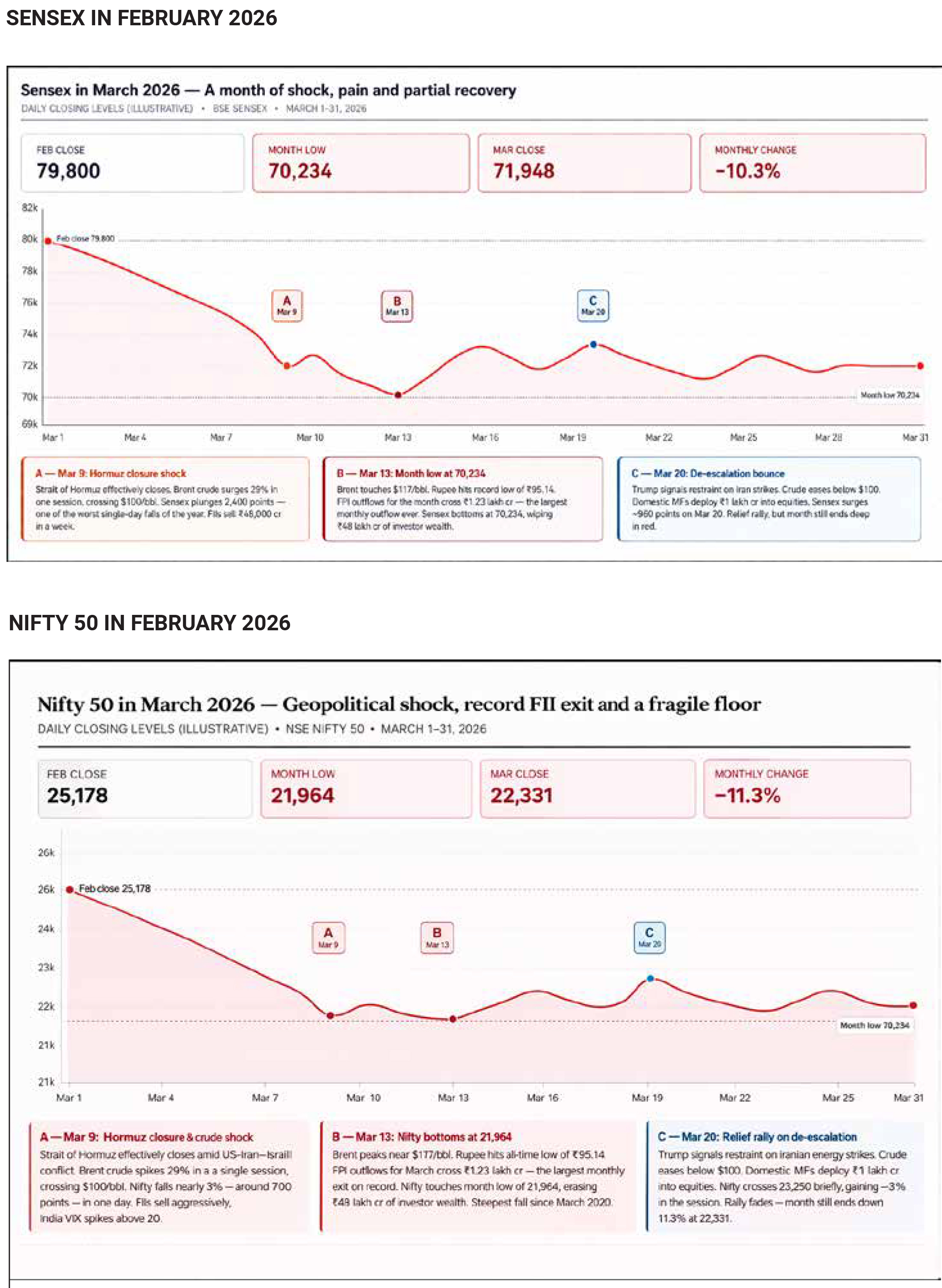
The pain was not evenly distributed across the market. The sectors that bore the heaviest losses were those most exposed to the dual threat of higher crude and tighter financial conditions — banks and NBFCs, automobile companies, aviation stocks, paint manufacturers, and logistics firms. These sectors together carry significant weight in both the Sensex and Nifty, which amplified the benchmark-level damage. There were pockets of resilience. Upstream oil and gas producers benefited from higher crude realizations and select IT and pharmaceutical names attracted some safe-haven interest on the back of rupee depreciation, which boosts export earnings. However, these sectors are relatively underweight in the large-cap indices compared to financials and consumer-facing businesses, so their gains were insufficient to offset the broader carnage. Interestingly, mid-cap and small-cap indices showed slightly better relative performance during parts of the month — but even these couldn't escape the overall negative tide. The month wasn't entirely without hope. In the latter half of March, comments from US President Donald Trump hinting at a more restrained approach toward Iranian energy infrastructure — effectively signalling a pause in the threat of direct military strikes — triggered sharp short-covering rallies. On 20 March, the Sensex surged nearly 960 points and the Nifty briefly crossed 23,250 as crude eased and risk appetite ticked up globally. Global equity funds recorded their largest weekly inflow in over two and a half months in the week ending 25 March, as markets reacted positively to the de-escalation signals. FII outflows from India slowed noticeably in this window, and some short covering in index heavyweights provided temporary support. But the key word is temporary. Each time Trump's tone softened, markets rallied. Each time his rhetoric hardened again — as it did in early April with fresh threats — the selling pressure returned. The de-escalation comments acted more as a brake on panic than as a genuine catalyst for a structural reversal. By month end, FII flows remained in net negative territory. March 2026 has been a sobering reminder of how quickly external shocks can overwhelm strong domestic fundamentals. India's GST collections, formal sector activity, and credit growth all remained reasonably healthy through the month — but these factors were simply no match for the combination of a $100 crude shock, record FII outflows, and a global flight to safety.
March 2026 was a difficult month for Indian debt
markets, with higher yields and softer prices across most
segments as a confluence of external shocks and
domestic structural pressures overwhelmed the RBI's
earlier liquidity support measures. From government
securities to corporate bonds, the broad message from
the fixed income market was consistent: the cost of
borrowing was moving up, and the rate cut narrative that
had animated markets earlier in the fiscal year was
losing conviction fast.
The benchmark 10-year government securities yield told
the clearest story, rising to approximately 7.00% by 30
March 2026 — up roughly 32 basis points over the month
and about 42 basis points higher than a year ago. This
was a meaningful move, reflecting a genuine repricing of
inflation risk and term premiums rather than a technical
blip. Shorter-dated instruments were relatively more
insulated, with RBI's liquidity operations helping cap the
worst of the selling at the short end, but longer-duration
bonds took the brunt of the pressure. State Development
Loans tracked the G-Sec move closely, with yields in the
6.6–7.8% band across the 3 to 30-year maturity
spectrum, and spreads over central government bonds
widening
as
investors demanded
additional
compensation for fiscal and geopolitical uncertainty at
the state level.
The dominant external driver was, of course, the West
Asia conflict and its most immediate market
consequence — Brent crude crossing $100 per barrel. For
India, a country that imports roughly 85% of its crude oil
requirements, a three-digit oil price is not just an energy
story; it is simultaneously an inflation story, a current
account story, and a currency story. Markets moved
quickly to price in all three dimensions. Higher crude
threatened to push CPI inflation — already nudging up to
around 3.2% in February 2026 from earlier lows — further
toward the upper bound of the RBI's comfort zone. This
effectively closed the window on meaningful near-term
rate cuts that bond markets had been partially pricing in,
forcing a broad yield curve adjustment, particularly
beyond the 3 to 5-year segment where rate cut
expectations had been most aggressively embedded.
Domestically, the debt market was grappling with a
supply problem that predated the geopolitical shock. The
central government had announced gross G-Sec
borrowing of ₹17.2 lakh crore for FY2027 — above
market expectations — and states had front-loaded their
own borrowing calendars aggressively in the January to
March quarter, adding approximately ₹5 trillion of net
supply. This volume of paper hitting the market
simultaneously kept yields structurally elevated,
regardless of RBI's compensating measures. The fiscal
deficit for FY2025-26 was revised to approximately 4.5%
of GDP, marginally above the original 4.4% target, and the
central government's debt-to-GDP ratio was estimated to
have risen to around 57% for FY26 — numbers that
reinforced the market's view that India would need to
issue substantial fresh debt for several years to come,
keeping term premiums firm at the long end.
The RBI was not passive. It had already injected
significant liquidity through LTROs, open market
operations, and repo channel easing in the preceding
months, and continued to provide support via buying in
the "Others" category during March. This helped prevent
a disorderly spike, particularly at the short end — T-bill
yields cleared in the 5.3–5.6% range, while OIS and
MIBOR-linked rates remained well below their peak
liquidity-tight phase levels. However, the incremental
demand generated by RBI operations was simply
insufficient to offset the heavy supply pressure and the
repricing of long-end risk, leaving the yield curve biased
higher on balance.
In the corporate bond space, March saw the highest
issuance volumes in eleven months, with around ₹990
billion raised — a sign that corporates rushed to lock in
funding ahead of fiscal year-end. But the pricing told a
less comfortable story: spreads over G-Secs widened to
above 80 basis points from an earlier 50–60 basis point
range, as risk premiums for credit expanded in line with
the geopolitical and inflation backdrop. Major public
sector banks including SBI, Bank of Baroda, Indian Bank,
and Union Bank issued 7 to 10-year paper at yields in the
7.1–7.2% band — meaningfully higher than equivalent
issuances earlier in the fiscal year.
For debt mutual fund investors, the month delivered a
sobering reality check. Longer-duration G-Sec funds
reported flat to negative returns as underlying bond
prices fell in tandem with rising yields. Short-duration
and liquid fund investors fared better, sheltered by RBI's
short-end support and the relative stability of T-bill rates.
There was some rotation out of equity products — hit
hard by the West Asia-driven equity market sell-off — into
high-quality investment-grade debt, but this incremental
demand was not enough to reverse the prevailing
yield-up trend.
March 2026 proved to be a frustrating month for bullion
investors in India — plenty of drama, but ultimately little
reward. Both gold and silver ended the month lower than
where they started, despite a geopolitical backdrop that, in
theory, should have been tailor-made for safe-haven assets.
The West Asia conflict delivered sharp spikes and
gut-wrenching reversals in equal measure, leaving the
month characterised less by a clear directional trend and
more by exhausting whipsaw volatility that tested the nerves
of traders and long-term holders alike.
Gold in the domestic market started March around ₹14,309
per gram before sliding to a net lower close by month end,
with intraday swings of several hundred rupees per 10
grams becoming a near-daily occurrence. The month's most
dramatic session came on 26 March, when gold surged over
₹3,000–3,700 per 10 grams in a single day on the back of
global risk-off sentiment and a briefly softer dollar — but this
move came after the metal had already given up far more
ground earlier in the month. Silver's journey was even more
turbulent. Starting near ₹2.95 lakh per kilogram, silver briefly
touched ₹3.15 lakh in early March before collapsing to
approximately ₹2.5 lakh by month end — a decline of roughly
5% that significantly outpaced gold's losses, reflecting
silver's greater sensitivity to both industrial demand
conditions and speculative positioning.
The story of why bullion underperformed despite an active
regional conflict comes down to one dominant factor: crude
oil and its knock-on effects on interest rate expectations.
When US-Israel strikes on Iranian targets triggered the initial
escalation in late February and early March, gold and silver
responded exactly as textbook safe-haven logic would
predict — MCX gold briefly surged above ₹1.66 lakh per 10
grams while silver touched multi-month highs. But the same
conflict that drove investors into gold also drove Brent crude
above $100–110 per barrel, and that oil spike carried a sting
in its tail. Higher crude meant higher global inflation, which
in turn pushed back expectations of rate cuts from the US
Federal Reserve and other major central banks. Since gold
and silver are non-yielding assets, rising real rate
expectations make them structurally less attractive, and the
market wasted little time in repricing that reality. By
mid-March, gold had shed ₹12,000–20,000 per 10 grams
from its early-month peak, and silver had corrected by
₹30,000–1 lakh per kilogram — steep reversals that unfolded
even as the underlying geopolitical conflict showed no signs
of resolution.
The dollar and US Treasury yields added further
headwinds. While geopolitical uncertainty initially
softened the dollar and lent some support to bullion, the
subsequent shift toward a more hawkish rate narrative
strengthened the greenback and pushed up Treasury
yields — a combination that typically pressures
dollar-denominated gold and silver prices, with the effect
transmitted directly into Indian rupee-denominated
domestic rates.
A late-month bounce on de-escalation talk — gold up
roughly 1% and silver jumping nearly 4% on MCX in the
final sessions — offered some consolation but did not
meaningfully alter the month's outcome. March 2026
ultimately delivered the worst of both worlds for bullion:
maximum volatility with negative returns, as the
rate-hawkish oil shock proved a more powerful force than
the war-risk safe-haven premium.
March 2026 will be remembered as a historic and deeply
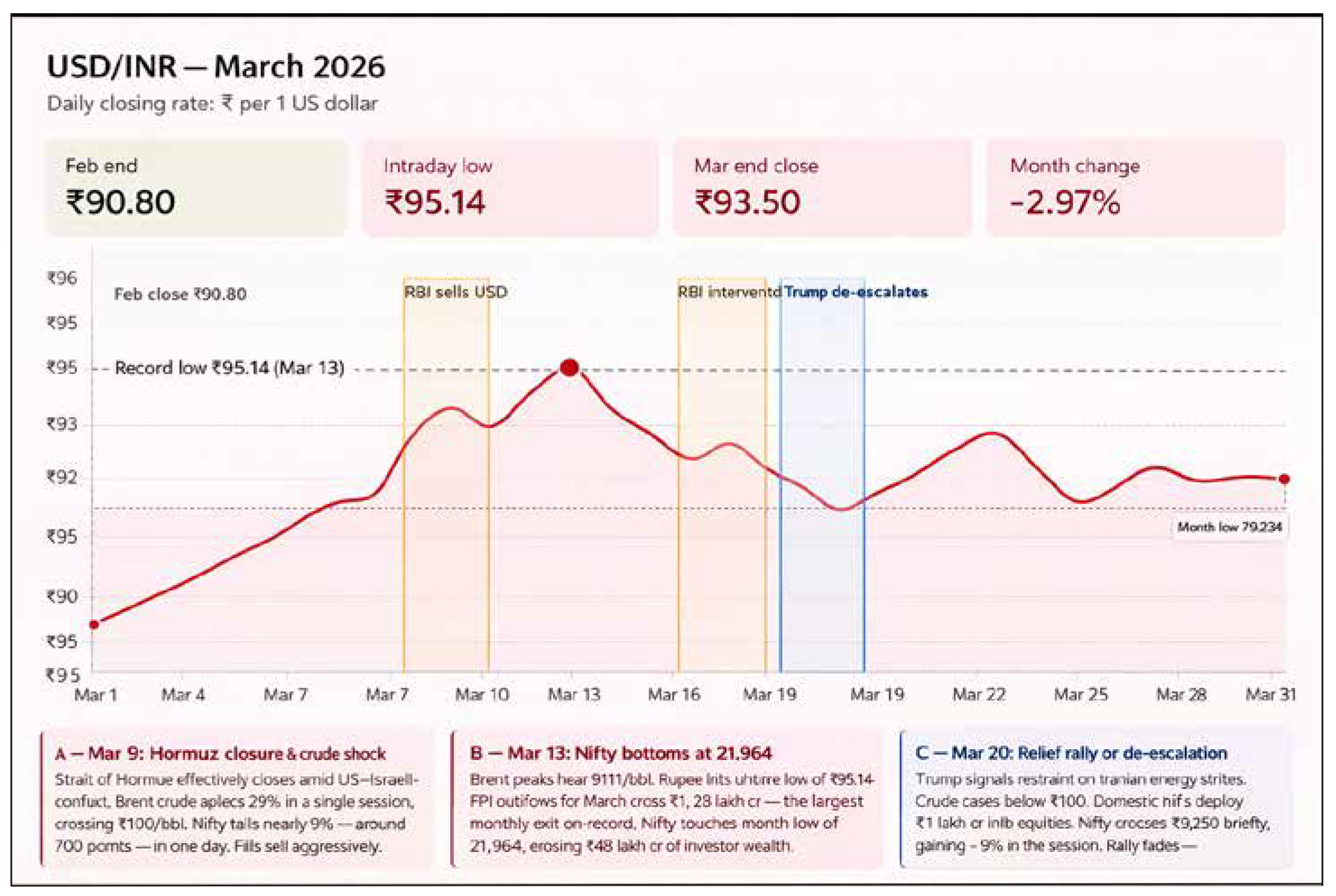
uncomfortable month for the Indian rupee. The currency
breached the psychologically significant ₹93 per US
dollar mark for the first time ever around 20 March, went
on to touch an intraday record low of approximately
₹95.14, and eventually settled around ₹93.50 by month
end — implying a monthly depreciation of roughly 2–3%
and a cumulative 12-month slide of nearly 9–10% from
the ₹84–85 levels that prevailed in mid-2025. In absolute
terms, this was one of the steepest single-month
depreciations the rupee has ever recorded.
The primary culprit was the West Asia conflict and its
most immediate consequence for India — a crude oil
price shock. Brent crude surged to $110–117 per barrel,
far above the RBI's assumed baseline of around $70,
dramatically expanding India's dollar-denominated oil
import bill. Since India sources roughly 80% of its crude
requirements from overseas and pays in dollars, the
spike translated directly into surging dollar demand in the
domestic foreign exchange market, putting relentless
downward pressure on the rupee. Compounding this was
the behaviour of Foreign Institutional Investors, who
turned aggressive net sellers of Indian equities through
the month, repatriating an estimated $8–10 billion out of
the country and generating a sustained second wave of
dollar demand that the market struggled to absorb.
The global backdrop offered no relief. The US dollar index
traded near multi-month highs around 99–100, as the
Federal Reserve's higher-for-longer rate narrative drew
capital into dollar assets and away from emerging market
currencies. In this environment, the rupee was not uniquely
weak — most EM currencies underperformed — but India's
specific exposure to oil imports and the scale of FII outflows
made the pressure more acute than in peer economies.
The RBI intervened repeatedly and visibly, selling dollars
through state-owned banks ahead of market open to prevent
disorderly falls, tightening speculative position limits on
banks' net open foreign exchange exposure, and allowing
forex reserves to fall by approximately $30–31 billion over
the month to fund its market operations. These interventions
were not without effect — they meaningfully reduced
intraday volatility on several occasions, delivered sharp
one-day rupee recoveries after record-low breaches, and
prevented what could have been a more disorderly free fall.
However, they could not alter the fundamental direction of
travel. Each RBI-supported bounce was quickly eroded by
fresh oil-linked dollar demand and FII outflow pressure,
making the central bank's support look more like a series of
controlled pauses than a genuine floor.
The rupee's slide fed back into the broader economy and
markets — worsening the import inflation outlook,
complicating the RBI's room to cut rates aggressively, and
amplifying the Sensex and Nifty corrections through the FII
selling channel. Strategists were broadly aligned in their
assessment: durable rupee stabilisation will require lower
crude prices and a return of foreign inflows — not simply
more intervention, which is already proving costly in terms of
reserve depletion and policy flexibility.
March 2026 delivered one of the most violent crude oil price
shocks in recent memory. Brent crude surged from around
$70–75 per barrel in late February to a peak of $110–117 per
barrel in the third week of the month, before settling just
above $100 per barrel by month end — a monthly gain of
roughly 40–50% that sent tremors through every
oil-importing economy, none more so than India. WTI, the US
benchmark, tracked an almost identical trajectory,
underscoring the purely geopolitical nature of the shock
rather than any region-specific supply quirk.
The proximate cause was the effective closure of the Strait
of Hormuz in early March, triggered by military incidents
directly linked to the escalating US–Israel–Iran conflict in
West Asia. The Strait is the single most critical choke point in
global oil infrastructure, carrying approximately 20% of
the world's oil supply on any given day. Its closure — even
partial or threatened — is the kind of event oil markets
have long feared and never fully priced in during
peacetime. When it materialised, the reaction was
immediate and extreme: Brent jumped roughly 29% in a
single session on 9 March, briefly crossing $100 per
barrel before continuing to climb, as traders scrambled to
price in the prospect of a sustained supply disruption
from Persian Gulf producers that supply the bulk of Asia's
crude imports.
What made the shock particularly difficult to contain was
the near absence of credible shock absorbers. Global oil
markets were already running close to capacity entering
March, with limited spare output available from either
OPEC+ members or non-OPEC producers. Alternative
shipping routes and pipeline options cannot replicate, at
any meaningful speed, the volumes that transit Hormuz
daily. This structural vulnerability meant that even a
partial or temporary disruption generated a price
response far larger than the actual barrels affected —
traders were pricing in duration risk, not just the
immediate shortfall. Algorithmic and momentum-driven
buying in derivatives markets amplified the physical
supply fear, keeping volatility elevated throughout the
month with Brent oscillating between $96 and $110 per
barrel on each fresh geopolitical headline.
OPEC+ attempted a response, but it was too modest to
matter. The group announced a production increase of
approximately 206,000 barrels per day beginning in April
— slightly above market expectations of 137,000 bpd but
representing less than 0.2% of global daily demand. Brent
prices continued rising even after the announcement, as
markets correctly read the move as a confidence signal
rather than a genuine supply solution. The cartel's
influence on near-term price levels was muted; what
drove prices was the duration of Hormuz disruption risk,
not quota arithmetic.
For India, the impact was acute and multi-dimensional. In
rupee terms, crude surged from approximately ₹5,700 per
barrel at end-February to over ₹9,000–9,500 per barrel
intra-month, before moderating to around ₹9,200–9,300
by month end. This translated directly into a widening
import bill, rupee depreciation pressure, bond yield rises,
and the equity market sell-off that defined Indian
financial markets through March — making crude oil the
single most consequential external variable of the
month.
March 2026 will be remembered as the month Indian
mutual funds stepped up as the market's most
consequential domestic stabiliser. As Foreign Portfolio
Investors pulled out a record ₹1.23 trillion from Indian
equities — the largest monthly FPI outflow ever recorded
— domestic mutual funds deployed an estimated ₹1.05
trillion into the market, absorbing the bulk of that external
selling and preventing what could have been a far more
catastrophic correction. Analysts broadly agree that
without this domestic buying cushion, the Nifty's 11%
monthly decline — already the steepest since March 2020
— could have deepened to 15–18%.
The buying was deliberate and concentrated. Fund
managers reduced cash holdings and scaled into
large-cap and index-linked schemes during the worst
sell-off days, particularly when crude oil crossed $110
per barrel and war headlines intensified. This demand
flowed directly into the Sensex and Nifty heavyweights —
banks, energy, infrastructure, and large-cap IT — helping
narrow intraday losses and underpin visible recoveries
in the final 7–10 trading sessions of the month. The SIP
engine remained a key enabler: with equity-oriented
schemes having received net inflows of over ₹25,000
crore in February, AMCs had fresh capital to deploy into
discounted equities without disrupting their flow
pipelines.
Not all segments fared equally well. Debt fund inflows
fell sharply, with investors rotating into liquid and
short-duration products for safety. Gold ETF inflows
collapsed by 78%, as investors gravitated toward
physical bullion. Passive scheme inflows also weakened
meaningfully. On the equity side, all mutual fund
categories ended the calendar year to date in negative
territory, with some focused and ELSS schemes down
12–16% — a painful reminder of concentration risk in
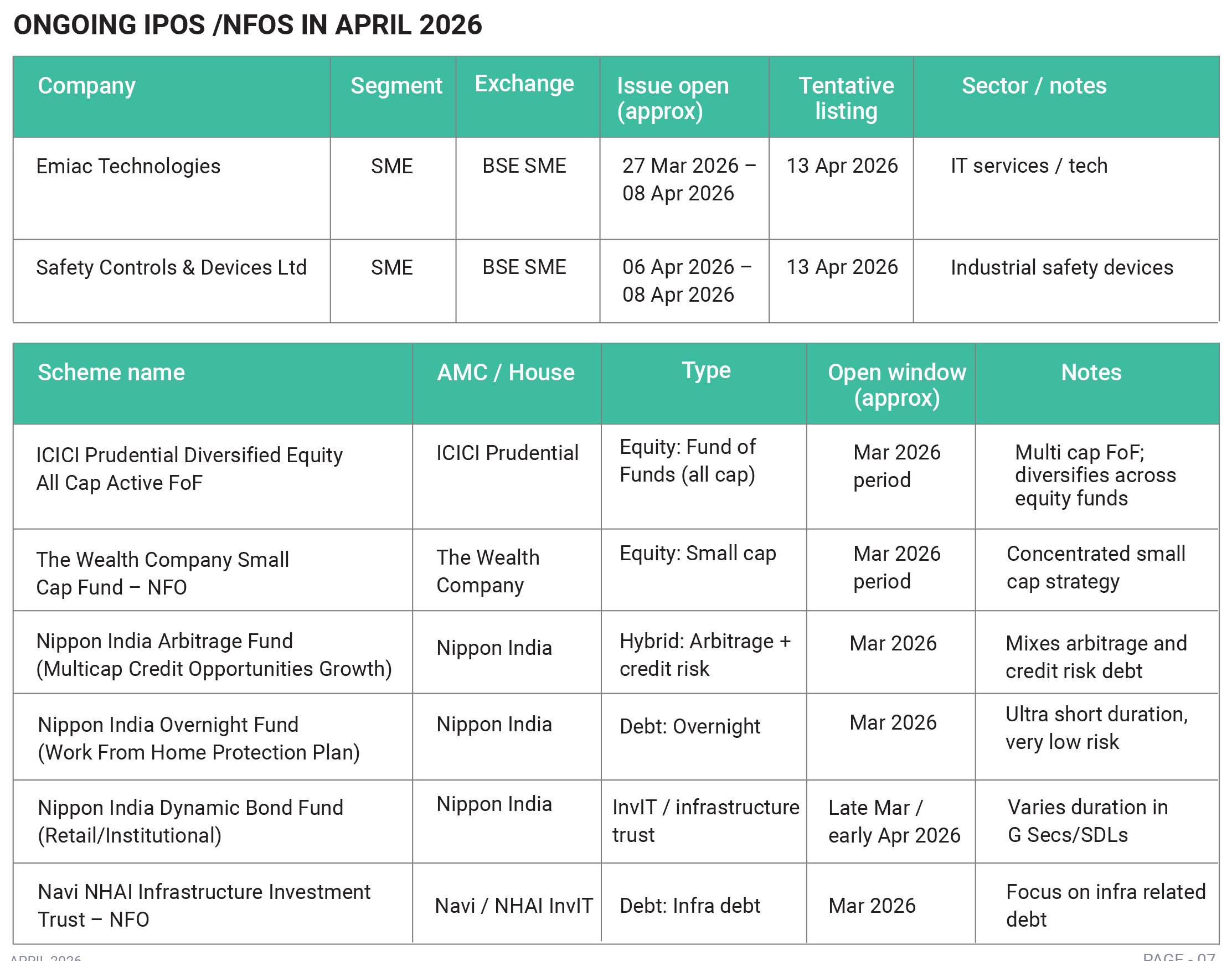
volatile markets. NFO activity, however, remained brisk,
with several new launches across equity, debt, and
arbitrage categories reflecting the industry's longer-term
confidence despite the near-term turbulence.