Topic 6: MUTUAL FUNDS: DEFENSIVE DEPLOYMENT
March 2026 will be remembered as the month Indian
mutual funds stepped up as the market's most
consequential domestic stabiliser. As Foreign Portfolio
Investors pulled out a record ₹1.23 trillion from Indian
equities — the largest monthly FPI outflow ever recorded
— domestic mutual funds deployed an estimated ₹1.05
trillion into the market, absorbing the bulk of that external
selling and preventing what could have been a far more
catastrophic correction. Analysts broadly agree that
without this domestic buying cushion, the Nifty's 11%
monthly decline — already the steepest since March 2020
— could have deepened to 15–18%.
The buying was deliberate and concentrated. Fund
managers reduced cash holdings and scaled into
large-cap and index-linked schemes during the worst
sell-off days, particularly when crude oil crossed $110
per barrel and war headlines intensified. This demand
flowed directly into the Sensex and Nifty heavyweights —
banks, energy, infrastructure, and large-cap IT — helping
narrow intraday losses and underpin visible recoveries
in the final 7–10 trading sessions of the month. The SIP
engine remained a key enabler: with equity-oriented
schemes having received net inflows of over ₹25,000
crore in February, AMCs had fresh capital to deploy into
discounted equities without disrupting their flow
pipelines.
Not all segments fared equally well. Debt fund inflows
fell sharply, with investors rotating into liquid and
short-duration products for safety. Gold ETF inflows
collapsed by 78%, as investors gravitated toward
physical bullion. Passive scheme inflows also weakened
meaningfully. On the equity side, all mutual fund
categories ended the calendar year to date in negative
territory, with some focused and ELSS schemes down
12–16% — a painful reminder of concentration risk in
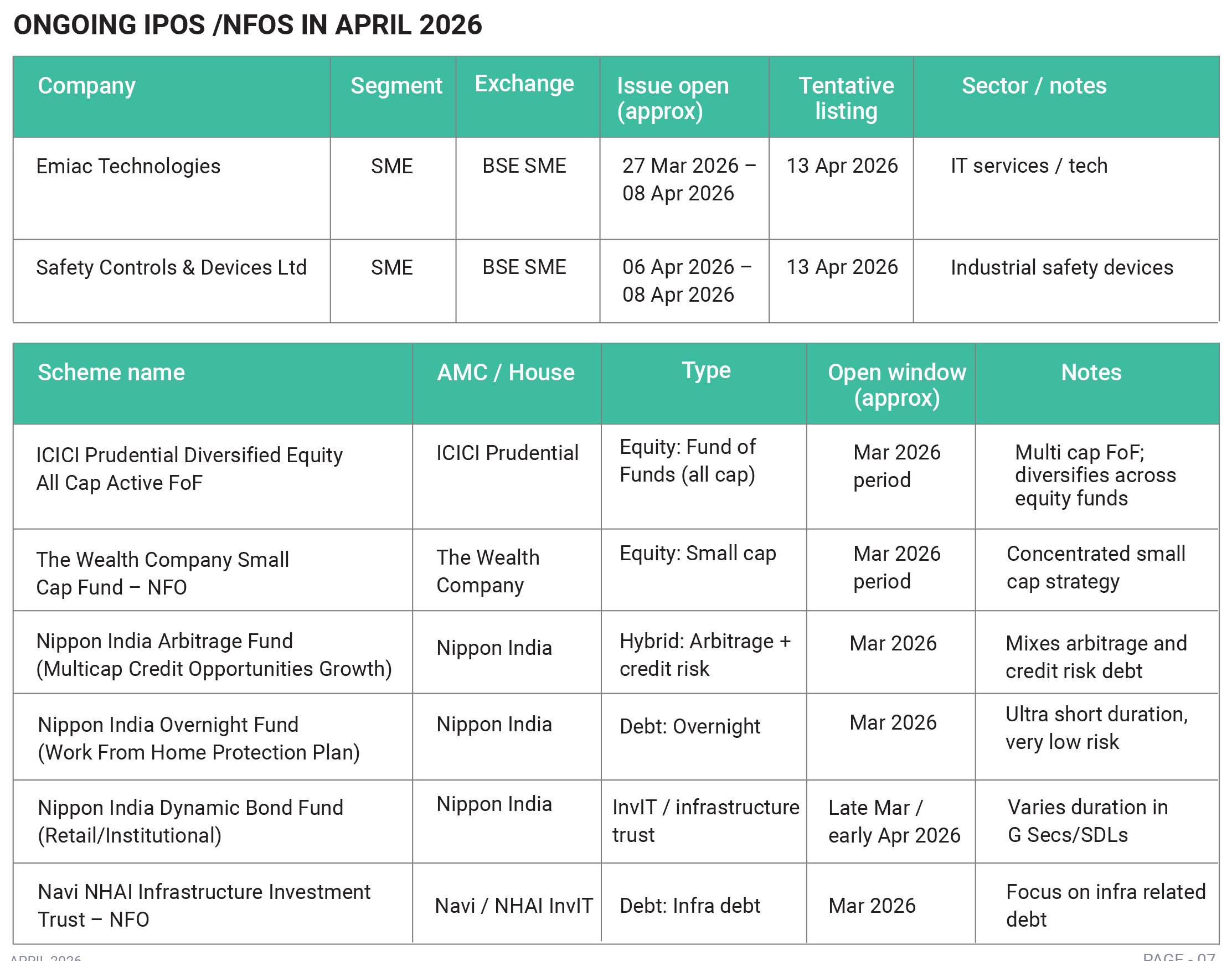
volatile markets. NFO activity, however, remained brisk,
with several new launches across equity, debt, and
arbitrage categories reflecting the industry's longer-term
confidence despite the near-term turbulence.