
Topic 5: CRUDE: IMPORT SHOCK
March 2026 delivered one of the most violent crude oil price
shocks in recent memory. Brent crude surged from around
$70–75 per barrel in late February to a peak of $110–117 per
barrel in the third week of the month, before settling just
above $100 per barrel by month end — a monthly gain of
roughly 40–50% that sent tremors through every
oil-importing economy, none more so than India. WTI, the US
benchmark, tracked an almost identical trajectory,
underscoring the purely geopolitical nature of the shock
rather than any region-specific supply quirk.
The proximate cause was the effective closure of the Strait
of Hormuz in early March, triggered by military incidents
directly linked to the escalating US–Israel–Iran conflict in
West Asia. The Strait is the single most critical choke point in
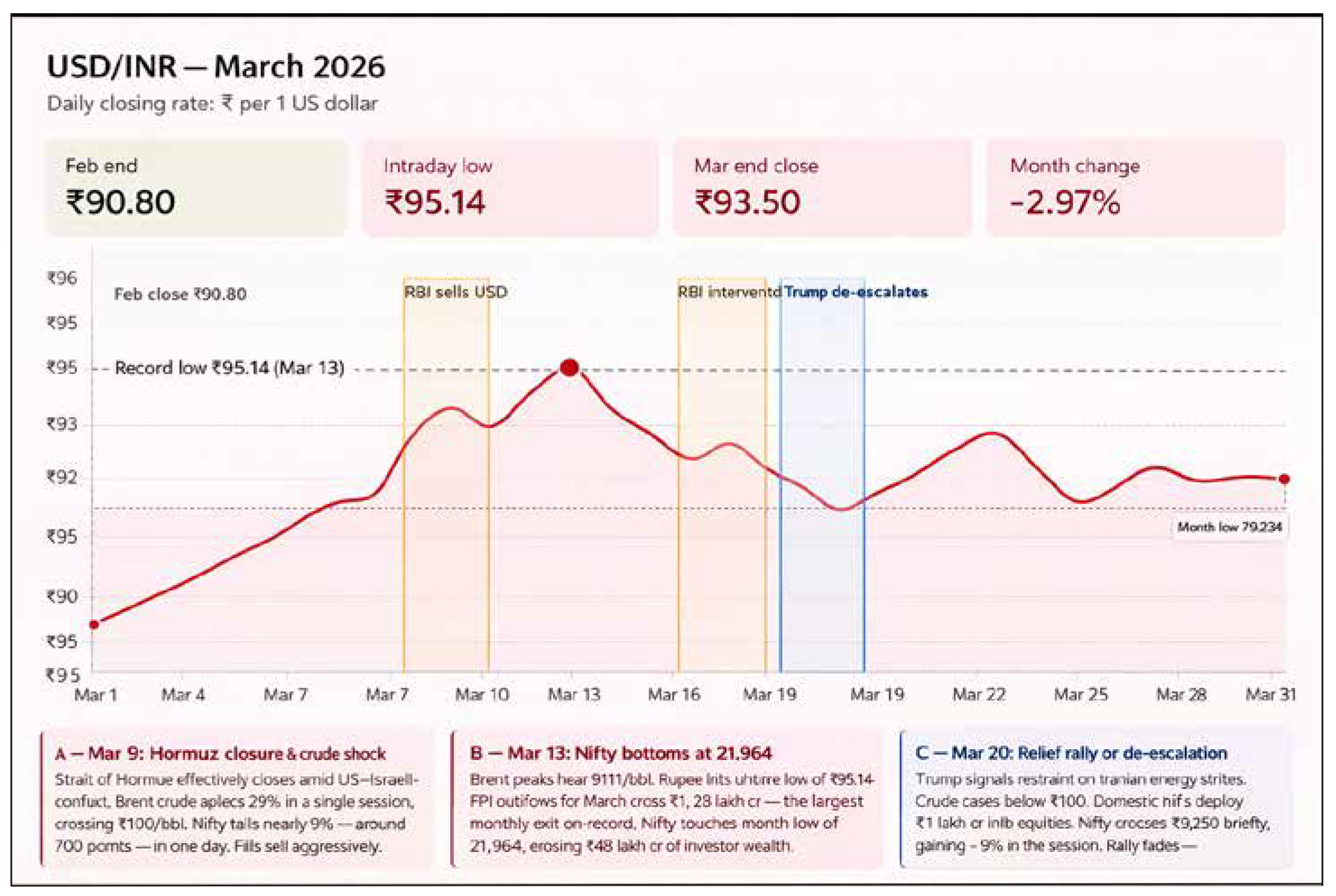
global oil infrastructure, carrying approximately 20% of
the world's oil supply on any given day. Its closure — even
partial or threatened — is the kind of event oil markets
have long feared and never fully priced in during
peacetime. When it materialised, the reaction was
immediate and extreme: Brent jumped roughly 29% in a
single session on 9 March, briefly crossing $100 per
barrel before continuing to climb, as traders scrambled to
price in the prospect of a sustained supply disruption
from Persian Gulf producers that supply the bulk of Asia's
crude imports.
What made the shock particularly difficult to contain was
the near absence of credible shock absorbers. Global oil
markets were already running close to capacity entering
March, with limited spare output available from either
OPEC+ members or non-OPEC producers. Alternative
shipping routes and pipeline options cannot replicate, at
any meaningful speed, the volumes that transit Hormuz
daily. This structural vulnerability meant that even a
partial or temporary disruption generated a price
response far larger than the actual barrels affected —
traders were pricing in duration risk, not just the
immediate shortfall. Algorithmic and momentum-driven
buying in derivatives markets amplified the physical
supply fear, keeping volatility elevated throughout the
month with Brent oscillating between $96 and $110 per
barrel on each fresh geopolitical headline.
OPEC+ attempted a response, but it was too modest to
matter. The group announced a production increase of
approximately 206,000 barrels per day beginning in April
— slightly above market expectations of 137,000 bpd but
representing less than 0.2% of global daily demand. Brent
prices continued rising even after the announcement, as
markets correctly read the move as a confidence signal
rather than a genuine supply solution. The cartel's
influence on near-term price levels was muted; what
drove prices was the duration of Hormuz disruption risk,
not quota arithmetic.
For India, the impact was acute and multi-dimensional. In
rupee terms, crude surged from approximately ₹5,700 per
barrel at end-February to over ₹9,000–9,500 per barrel
intra-month, before moderating to around ₹9,200–9,300
by month end. This translated directly into a widening
import bill, rupee depreciation pressure, bond yield rises,
and the equity market sell-off that defined Indian
financial markets through March — making crude oil the
single most consequential external variable of the
month.